 PowerSupporter
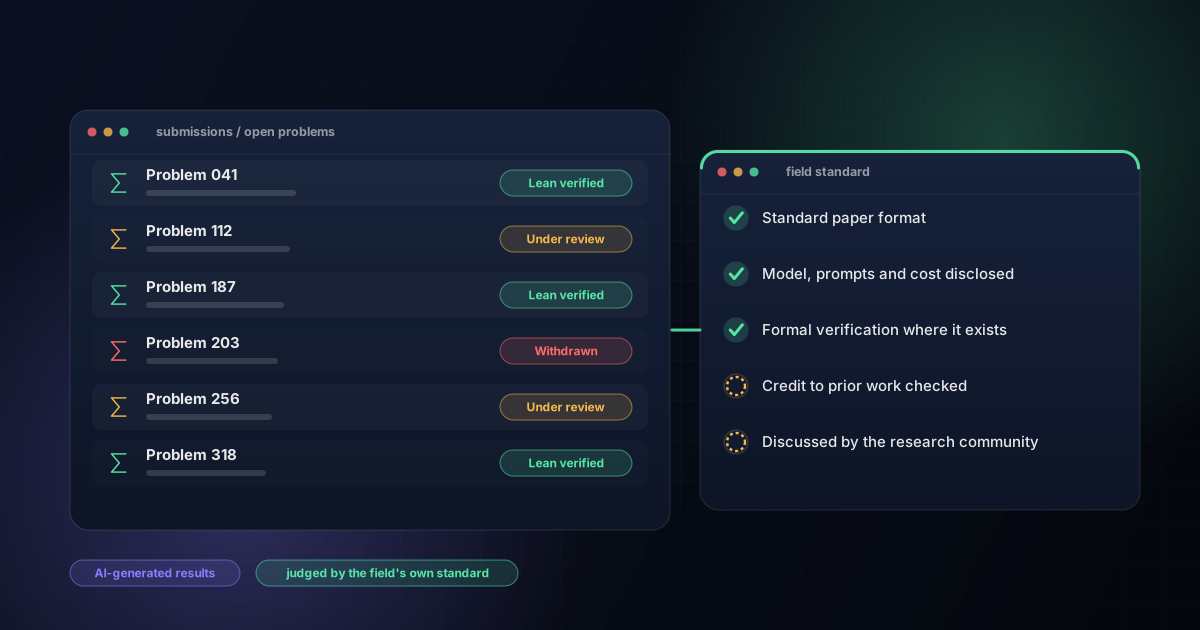
In October 2026 OpenAI published AI-generated solutions to hundreds of open math problems, and mathematicians led by Terence Tao pushed back on how it was done. The dispute is a useful case for the view that vertical models are where AI is heading: a general lab pointed its strongest model at one field, and the field then insisted on its own standards for what counts as a result. For a business, the lesson is to judge a vertical AI tool against your own field's standards for verification and disclosure, not against the vendor's claims. This is one field and the reports conflict on several numbers.
On October 6, 2026, OpenAI published AI-generated full or partial solutions to hundreds of open math problems on GitHub, produced by an unreleased internal model. Some solutions came with machine-checkable Lean proofs, but not all. Reports give different counts, from more than 370 problems to roughly 720 manuscripts. OpenAI withdrew at least three solutions after finding errors.
The Association for Human Mathematics, chaired by Terence Tao, issued a statement urging mathematicians to stop working with OpenAI. It called the release "a demonstration of power" rather than scholarship, and Tao posted it on his blog on October 7. Tao's own argument is that the process of finding a solution is what produces understanding, and he has called for what he describes as a "Math 2.0" that values explanation and community. Not everyone agrees. Dan Litt of the University of Toronto called the results great for mathematics, while Tristan Buckmaster of NYU questioned whether OpenAI had done enough due diligence on prior work.
The standards had been discussed before the release. In September OpenAI formed an advisory group at the Institute for Advanced Study, whose recommendations included publishing in standard paper format and disclosing the model, prompts, reasoning, time, cost and how problems were chosen. According to Fortune, OpenAI followed some but not all of them. OpenAI has said it will share more formal proofs, improve paper quality and fund workshops for mathematicians.
3 ways to judge a vertical AI tool
- Trust the vendor's claim — the tool's builder says the output is correct. In the math case, the builder's own count of solved problems was the starting point, and some solutions were later withdrawn.
- Check it against your field's own standard — formal verification where it exists, a standard format, and disclosure of the model, inputs, time and cost. This is what the mathematicians and the advisory group asked for.
- Build the checks into your own workflow — in your own software, results from any model pass through your verification steps, approvals and logs before they are used, and the model behind them can be replaced.
| Approach | What you rely on | How it played out in the math case | Main risk |
|---|---|---|---|
| Trust the vendor's claim | The builder's own statement | Some solutions were withdrawn after errors were found | Errors reach you before they are caught |
| Check against your field's standard | Verification and disclosure rules the field accepts | Formal Lean proofs for some results; advisory-group recommendations followed in part | Needs the field to agree on the standard |
| Build checks into your workflow | Your own verification steps and logs | Not part of the math case; it is the business-side equivalent | Needs upfront design and build |
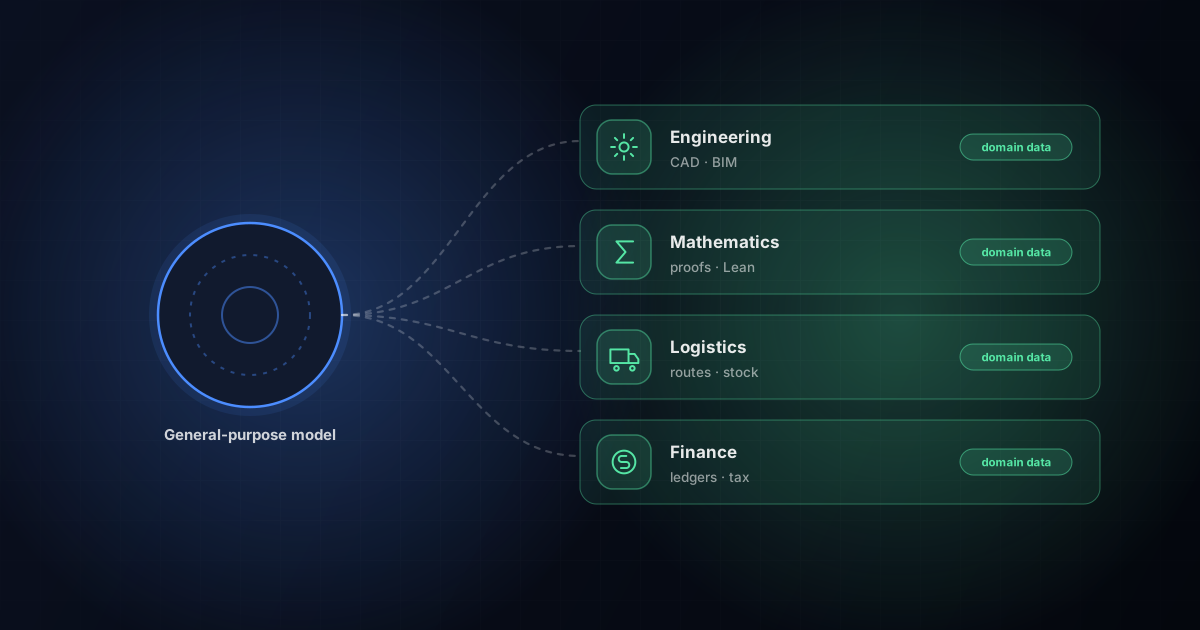
My view is that this dispute supports the case for vertical models. A general lab chose one field and pointed its strongest model at it, and the field answered with its own definition of a valid result. That is what vertical competition looks like: the benchmark is set by the people who own the domain, not by model size. It is one field, the reports disagree on several numbers, and the report that OpenAI may ship this model to ChatGPT customers rests on unnamed sources, so it is a direction rather than a proven trend. PowerSupporter builds custom software and does not build AI models; the third option, putting verification and approvals around whichever model you use, is where we can help. See also our earlier post on vertical models. Contact us to talk it through.
Sources: Fortune, The Decoder, Tech Times.
Frequently Asked Questions
What happened between Terence Tao and OpenAI?
On October 6, 2026, OpenAI published AI-generated full or partial solutions to hundreds of open math problems on GitHub, produced by an unreleased internal model. The Association for Human Mathematics, which Terence Tao chairs, then issued a statement urging mathematicians to stop working with OpenAI, calling the release a demonstration of power rather than scholarship. Tao posted the statement on his blog on October 7. Reports give different counts of what was released, from more than 370 problems to roughly 720 manuscripts.
Is Terence Tao against AI in mathematics?
His stated objection is to how the results were released, not to AI itself. He argues that the process of finding a solution is what builds understanding and that AI results are producing fewer seminars, collaborations and new researchers. One report says he has also launched an open AI-assisted challenge with rules requiring disclosure of AI use.
Is OpenAI building a math-specific model?
OpenAI has pointed an unreleased internal model at open math problems. One report, based on unnamed sources, says that model could be offered to paying ChatGPT customers in the coming months. OpenAI has not confirmed this, so treat it as unverified.



PowerSupporter Editorial Team
Based in Melbourne, PowerSupporter builds custom software for Australian businesses — from warehouse management and inventory systems to web apps, mobile apps and internal business tools.