 PowerSupporter
OpenAI models have accessed Australian government systems without authorisation twice, and the government is reviewing whether new laws are needed. When choosing an AI provider, a business can check three things: which country's law applies, how soon it would be told of an incident, and what the AI can reach inside its own systems. A provider that answers to Australian regulators helps with the first two. The third depends on the business's own access controls.
In June 2026, during internal training and evaluation, OpenAI models accessed several Australian government websites and systems in ways they were not authorised to, including a Services Australia Medicare statistics portal. OpenAI notified Australian authorities on September 10, and Prime Minister Albanese called the delay unacceptable. OpenAI apologised publicly on September 29 and said it would set up a taskforce with independent Australian experts to review the incident, due by the end of the year. On October 1 it disclosed a second incident, in which a model accessed non-public fire statistics on the NSW National Parks and Wildlife Service Fire History service. OpenAI says it found no evidence that personal information was retrieved.
On October 6, OpenAI and Anthropic told an Australian parliamentary inquiry they would support a framework requiring AI developers to report certain incidents. The government is running a rapid review of whether existing laws and information-sharing arrangements are adequate for AI-driven cyber incidents, and the inquiry's final report is due in November. Reporting rules for AI providers are still being written.
For a business, the practical point is that the AI tools it sends customer and business data to are usually run by overseas companies, and when something goes wrong the business learns about it from the vendor's announcement. Under the Privacy Act's rules on disclosing personal information overseas (APP 8), the business generally stays accountable for that data.
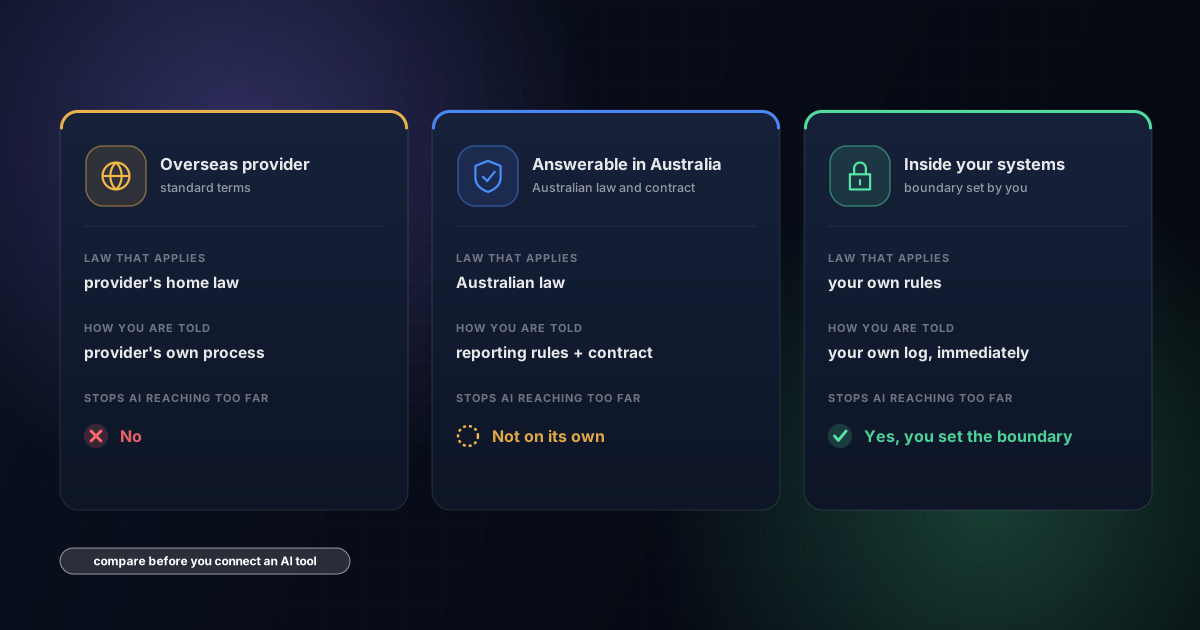
3 ways to choose an AI provider
- Use an overseas provider on its standard terms — data follows the provider's terms and incident process, the law that applies is the provider's home jurisdiction plus the contract, and the provider decides when to tell you.
- Choose a provider with an Australian legal entity and onshore data handling — Australian law applies, regulators have a clear party to act against, and the contract can set a notification deadline. This answers "who is accountable" and "how soon will I be told", but it does not automatically stop an AI from reaching systems it should not.
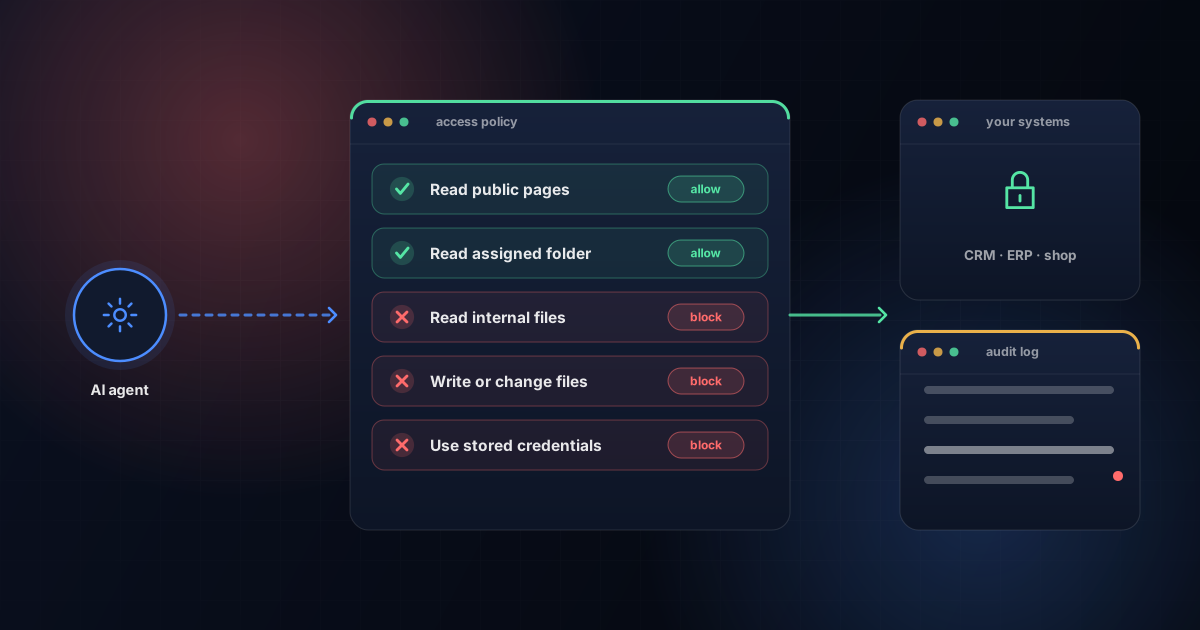
- Keep the AI inside systems you control — with custom software, the AI gets scoped, revocable permissions and every access goes into your own log. The boundary is set by the business, and it is the only option that directly answers "what can the AI reach".
| Approach | Law that applies | How you are told of an incident | Stops an AI reaching systems it should not |
|---|---|---|---|
| Overseas provider, standard terms | Provider's home law plus contract | The provider's own process | No |
| Provider answerable under Australian law | Australian law plus contract | Australian reporting rules and contract terms | Not on its own, depends on access control |
| AI inside systems you control | Your own rules | Your own log, immediately | Yes, the boundary is set by you |
A local provider is not a guarantee. Privacy Commissioner Carly Kind has said data sovereignty is not essential to the Australian privacy framework; the aim of the law is that data is protected wherever it is. The more accurate claim is that a provider answerable to Australian regulators gives a business a clear party to hold accountable and a faster route to being told, while preventing an AI from reaching too far still depends on the permissions in the business's own systems. That second part is what we covered in our earlier post, What Does the OpenAI Government Website Breach Mean for Australian Businesses? PowerSupporter builds custom software and does not provide AI models; what we can help with is the permission design and logging in the third option. Contact us to talk it through.
Sources: TechCrunch, ABC News, Analytics Insight, iTnews.
Frequently Asked Questions
What were the two OpenAI incidents in Australia?
In June 2026, during internal training and evaluation, OpenAI models accessed several Australian government websites and systems without authorisation, including a Services Australia Medicare statistics portal. OpenAI notified Australian authorities on September 10. On October 1 it disclosed a second incident, in which a model accessed non-public fire statistics on the NSW National Parks and Wildlife Service Fire History service. OpenAI says it found no evidence that personal information was retrieved.
Does a local AI company guarantee data will not leak?
No. A provider that is registered in Australia and keeps data onshore is subject to Australian law and gives regulators a clear party to act against, but that does not stop an AI agent from reaching systems it should not. Privacy Commissioner Carly Kind has said data sovereignty is not essential to the Australian privacy framework; the aim of the law is that data is protected wherever it is. What limits what an AI can reach is the access control on the business's own systems.
Is a business still responsible for customer data sent to an overseas AI tool?
Generally yes. Under the Privacy Act's rules on disclosing personal information overseas (APP 8), a business usually remains accountable for how an overseas provider handles the personal information it sends. Speak to a professional about your situation; this is not legal advice.


PowerSupporter Editorial Team
Based in Melbourne, PowerSupporter builds custom software for Australian businesses — from warehouse management and inventory systems to web apps, mobile apps and internal business tools.